
A Three-Year-Old Who Loved Beets
People often ask me how I became so fascinated by French school lunches. Like many of the best things in life, it wasn’t planned. It happened almost by accident and gradually took on a life of its own.
When I first moved to France several decades ago, I wasn’t setting out to become “the French school lunch person.” I was simply an American mother raising three children in the French school system, learning as I went. By the time my youngest started preschool, I thought I had the whole parenting-in-France thing more or less figured out.
Then one afternoon, everything changed because of a beet.
We were doing the weekly grocery shop at our local Carrefour—not a charming Provençal market overflowing with lavender and bunches of fresh thyme, but an ordinary supermarket where I was trying to get in and out as quickly as possible. My three-year-old daughter, in her first year of preschool, was sitting in the little seat of the shopping cart while her two older brothers wandered nearby.
Suddenly she leaned forward and pointed excitedly.
“Mama! Betterave! Betterave!”
I looked around, completely confused.
“What?”
She pointed again.
“Please, Mama! Betterave!”
Eventually I realized she was pointing at a pile of fresh beets, still covered in dirt.
Now, I should probably confess something. I absolutely love vegetables. I’d happily eat almost anything in the produce section. Except beets. For reasons I still can’t explain, I’ve never liked them. To me they taste vaguely like dirt, and I’d happily go my entire life without eating another one. Since I did most of the cooking at home, beets simply never appeared on our table.
“You want these?” I asked, holding one up.
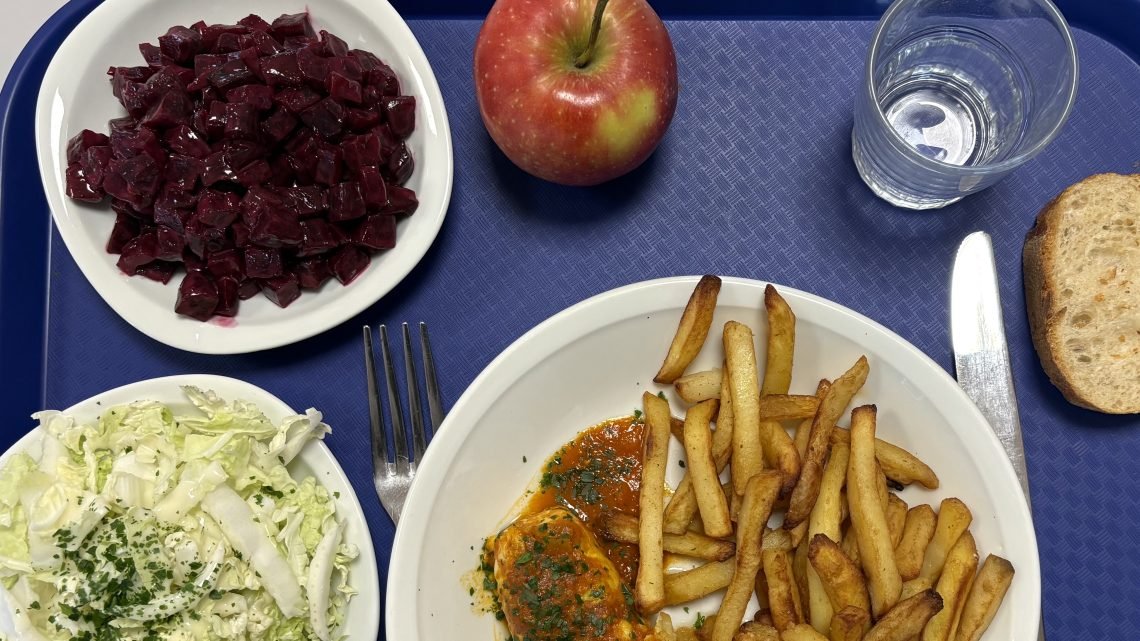
“Yes!” she said enthusiastically. “We eat betterave at the cantine. I loooove it!”
I remember staring at her in disbelief. My three-year-old wanted beets. Not because I had introduced them. Because she’d discovered them at school. So I bought the beet.
Then I got home and realized I had absolutely no idea what to do with it. After a quick recipe search and a fair amount of guesswork, I produced my very first beet salad. To my surprise, all three of my children happily ate it.
Then came the verdict. “It’s not like the cantine.” Apparently, the school version was better.
That little exchange stayed with me. Not because I suddenly thought French school lunches were extraordinary, but because it made me curious. If three-year-olds were happily eating beet salad at school, what else were they eating? Over the following weeks, I started asking my children about lunch every day.
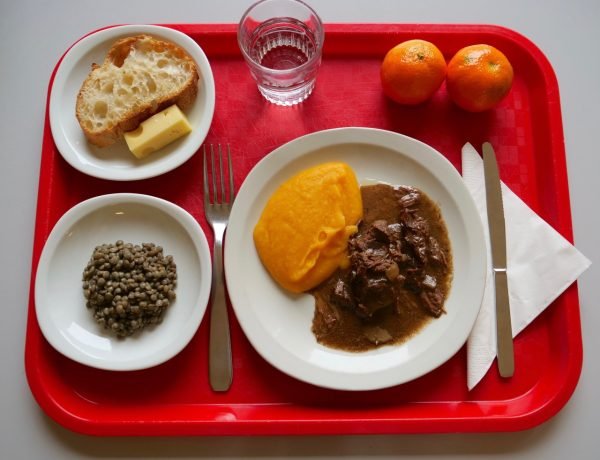
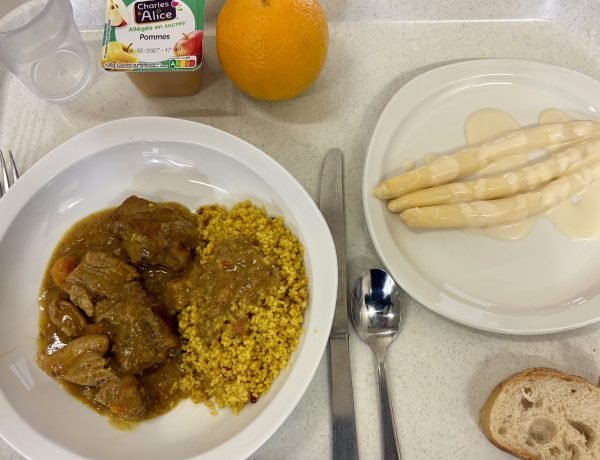
Out came stories about chicken fricassée, tomato rice, beef bourguignon, cheeses I had barely learned to pronounce, and fruits and vegetables that seemed completely ordinary to them. They regularly asked me to recreate dishes from school at home.
I tried. My versions of their favorite French school lunches were never quite the same. And the journalist in me couldn’t let it go.
For a complete overview of the French school lunch system, see → French School Lunches: How They Work Today.
Join my free monthly newsletter
for everyday French life, simple habits & sustainable wellbeing.
And get The French Guide to Everyday Wellbeing straight to your inbox!
My First Visit To A French School Cafeteria
Eventually I contacted our local mairie and asked if I could visit the school kitchen and cafeteria while researching an article for an American publication. To my surprise, they said yes. I didn’t know it at the time, but that visit would shape the next fifteen years of my career.
When I walked through the cafeteria doors, I expected to see a school lunchroom.
Instead, I found something that challenged almost every assumption I had about what a school meal could be. Children sat together at tables already set with real plates, glasses, and cutlery. Lunch unfolded in courses. Older children naturally helped younger ones. There was conversation, patience, and a rhythm that suggested lunch wasn’t simply a break in the school day—it was part of the school day.
That visit in 2014 became the subject of the very first article I ever wrote about French school lunches.
I had no idea at the time where it would lead. To my surprise, the story resonated with readers around the world. What I thought would be a niche article about a local French school cafeteria struck a chord with millions of people. It led to interviews and media coverage in France, conversations with journalists, and eventually opened doors into school kitchens across the country.
Working with a French school chef, I created a downloadable guide featuring some of the best-loved recipes served in French school cafeterias → Explore the French School Lunch Recipe Guide
Why I Kept Writing About French School Lunches
Years later, I find myself back where I started—but this time on my own blog and social media, and sharing these stories myself. To my surprise, they’re resonating with millions of people once again, and I’m still fascinated by exactly the same question that began in a supermarket produce aisle. How do children learn what “normal” food looks like?
Looking back, I don’t think this story is really about a beet. It’s about curiosity.
A three-year-old doesn’t ask for beet salad because someone lectures her about healthy eating. She asks for it because it’s simply what she eats with her friends. Day after day, children are introduced to vegetables, fish, legumes, cheese, fruit, and homemade meals until those foods become familiar rather than unusual.
Looking back, the surprising part wasn’t that my daughter liked beets. The surprising part was that nobody around her thought it was surprising at all.
A dirty little beet in a Carrefour shopping cart opened the door to a question I’ve been exploring ever since.
And all these years later, I’m still following the answer.
Read More
👉 French School Lunch Menu: Typical Week in 2026
👉 Five Reasons French School Lunches Are Important (It’s Not The Food)
👉 A Look Inside A French School Cafeteria Kitchen
More From France
If you’re curious about how France nurtures healthier habits — from school lunches to everyday food, movement, and wellbeing — I share practical tips and stories each month. Sign up for the free newsletter below and receive my guide, The French Guide to Everyday Wellbeing, straight to your inbox. Merci!
Come see it for yourself!
Follow along on Instagram and TikTok for real footage from inside French school cafeterias and kitchens, plus everyday life in France.