
People often assume French children simply love vegetables and unfamiliar foods. That they are naturally adventurous eaters.
But after years of observing school cafeterias in France, volunteering at the cantine, and speaking with school chefs and staff, I’ve come to a different conclusion.
French kids aren’t born less picky.
They grow up in an environment where food simply isn’t presented as a choice.
Meals appear on the table. Children are invited to eat them. And while no one is forced to finish everything, the menu itself is rarely negotiable.
In other words: this is what we’re eating today.
That small but important difference shapes how children approach food from the beginning.
For a complete overview of the French school lunch system, see → French School Lunches: How They Work Today.
Why French Kids Aren’t Picky Eaters
French kids are less picky eaters largely because meals are structured and adults set the menu. Children are encouraged to taste unfamiliar foods, meals happen at predictable times, and the same foods appear repeatedly over time. Instead of negotiating what children will eat, French families and schools focus on exposure and routine, which gradually expands children’s tastes.
Join my free monthly newsletter
for everyday French life, simple habits & sustainable wellbeing.
And get The French Guide to Everyday Wellbeing straight to your inbox!
A Culture Where Adults Set the Tone
Part of this comes from a broader cultural difference in how adults and children interact.
In France, children are generally not asked to weigh in on every decision that affects them. Adults tend to set the framework — whether that’s bedtime, school routines, or what appears on the dinner table.
This isn’t about strictness. It’s simply understood that adults are responsible for organizing daily life, and children adapt to that structure.
French adults are generally comfortable being in charge. Teachers, parents, and cafeteria staff tend to set the rules and expect children to follow them. The approach can feel a little formal to outsiders — and yes, French classrooms can be famously strict (don’t get me started on the educational differences).
But when it comes to food, that clarity removes a lot of the negotiation that often surrounds meals.
What Writers Have Observed
The idea that French children are less picky isn’t new. Canadian author Karen Le Billon explored this question in her well-known book French Kids Eat Everything, where she documented her family’s experience moving to France and navigating the country’s food culture.
Many of the principles she describes — structured meals, tasting unfamiliar foods, and limited snacking — are things I’ve also seen repeatedly while volunteering in French school cafeterias.
Read more → French Kids Eat Everything
This exposure to a wide range of foods actually begins long before children reach elementary school. When French babies transition from milk to solid foods, they are introduced early to vegetables and fruits rather than highly processed baby foods. Many children then spend time in crèches where meals continue to emphasize simple, whole ingredients.
By the time they arrive in primary school cafeterias, most have already encountered a wide variety of flavors.
Read more → How French Daycare Introduces Children to Food
Modeling Starts at Home
This structure is reinforced outside the school cafeteria as well.
Most French parents cook one meal for everyone rather than preparing separate dishes for children. Meals tend to include a variety of vegetables, grains, and proteins, and children gradually become familiar with a wide range of foods simply because they appear regularly.
Another important factor is modeling.
French adults themselves are generally not very picky eaters. Children watch their parents eat the same foods that appear on their plates. Over time, this creates a positive feedback loop: adults eat widely, children follow their example, and the range of acceptable foods continues to expand.
Meals Are Treated as Real Meals
Another detail that shouldn’t be underestimated is how meals are presented.
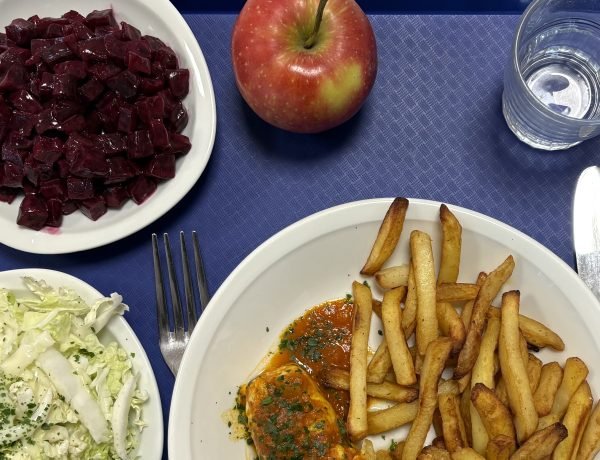
Whether at school or at home, meals are usually eaten sitting at a table with real plates, real silverware, glasses for water, and napkins.
Lunch in the cafeteria is treated as a proper meal, and dinner at home often follows the same pattern.
Families sit together. Children stay at the table. The meal has a beginning, a middle, and an end.
All of this sends a subtle message: this food matters, and this is when we eat.
Working with a French school chef, I created a downloadable guide featuring some of the best-loved recipes served in French school cafeterias → Explore the French School Lunch Recipe Guide
Hunger Helps
Another factor that often goes unnoticed is how meals are spaced throughout the day.
In France, children typically eat breakfast, lunch, a mid-afternoon snack, and dinner. Outside of those moments, food is generally not available.
That means children arrive at the table hungry.
Hunger makes a big difference. A child who has been grazing all afternoon is far more likely to reject unfamiliar foods. But when several hours have passed since the last meal, curiosity often wins out.
Children know another meal isn’t coming for several hours, so they are more willing to try what is offered.
“Il faut goûter”
One phrase I hear constantly in the cafeteria is il faut goûter — you have to try it.
Children are usually offered a very small portion to taste. Many of them will say yes, even if they’re unsure.
Sometimes they try it and leave the rest. That’s perfectly acceptable.
The important part is tasting.
Over the months I’ve volunteered at the cantine, I’ve watched children change their minds. Some come back a few minutes later to ask for more. Others return just to report that they tried it but didn’t like it.
Trying is the goal.
Expectations vs Reality
Children sometimes arrive with very firm ideas about what they don’t like.
Mushrooms are a good example. A child might ask quietly whether there are mushrooms in a dish. I usually ask if they are allergic. Almost always they say no — they just don’t like them.
So I tell them I don’t think there are mushrooms and give them a small portion.
Occasionally they side-eye me, wondering what this woman with the accent might be trying to pull. But because mushrooms are usually chopped finely into sauces or stuffings, they’re barely recognizable.
Almost no one comes back to complain.
Often the anticipation of disliking something is stronger than the taste itself.
Repetition Changes Everything
Another thing I’ve noticed is how often children assume they won’t like something before even tasting it.
Cooked broccoli is a good example.
At first, many children reacted with hesitation. But because the dish appeared regularly on the menu, they were asked to try it again and again in small amounts.
Over time the resistance faded.
The chef told me that broccoli — once met with skepticism — has become one of the most popular dishes in the cafeteria. When it appears on the menu now, children notice.
I’ve even seen them high-five each other about it.
Consistency Shapes Taste
Consistency also shapes expectations.
Several years ago, the chef at our school decided she would stop purchasing flavored or sweetened yogurts. At first this applied only to the crèche (daycare), where the youngest children aren’t given added sugar.
Eventually the same rule was extended to the maternelle (pre-k and kindergarten) and primary school.
At the beginning some children commented on the change.
But over time it simply became normal.
Today yogurt at this cantine is always plain.
And no one questions it.
Children’s tastes are not fixed. They adapt to what becomes routine.
Expanding the Menu
The system isn’t rigid.
About once a month, the chef introduces something slightly more unexpected — mussels with fries, a new fish dish, or flavors that lean more Asian.
Watch → Mussels and Fries at a French School Lunch
When she does this, she watches closely to see how much is eaten and how much comes back uneaten.
If the reaction is mixed, she will often try the dish again another time to see whether familiarity improves the response.
It’s a quiet way of expanding children’s palates without abandoning the dishes that reliably work.
The Long Game
None of this is about winning a single meal.
France is playing a longer game.
Through calm authority, repetition, structure, and curiosity, children gradually become comfortable with a wide range of foods.
French children aren’t born adventurous eaters.
They grow into them.
Frequently Asked Questions
Why are French kids less picky eaters?
French children grow up with structured meals, limited snacking, and encouragement to taste unfamiliar foods. Because adults set the menu and foods are repeated regularly, children gradually become comfortable eating a wider variety of ingredients.
Do French kids really eat vegetables?
Yes. Vegetables appear regularly in both school lunches and family meals in France, and children are encouraged to try small portions repeatedly until they become familiar with them.
👉 For an easy vegetable dish, I’ve written about my French aunt’s easy baked ratatouille recipe here.
More From France
If you’re curious about how France nurtures healthier habits — from school lunches to everyday food, movement, and wellbeing — I share practical tips and stories each month. Sign up for the free newsletter below and receive my guide, The French Guide to Everyday Wellbeing, straight to your inbox. Merci!
Come see it for yourself!
Follow along on Instagram and TikTok for real footage from inside French school cafeterias and kitchens, plus everyday life in France.