
How do French school chefs decide what to serve children for lunch? How do they balance national nutritional requirements with food costs, seasonal ingredients and children’s food preferences? How are French school lunch menus created?
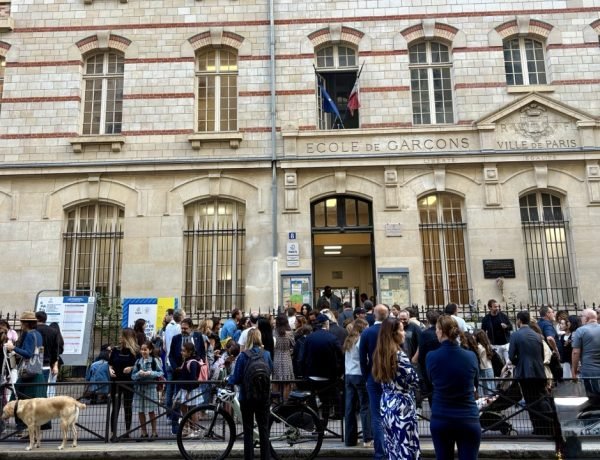
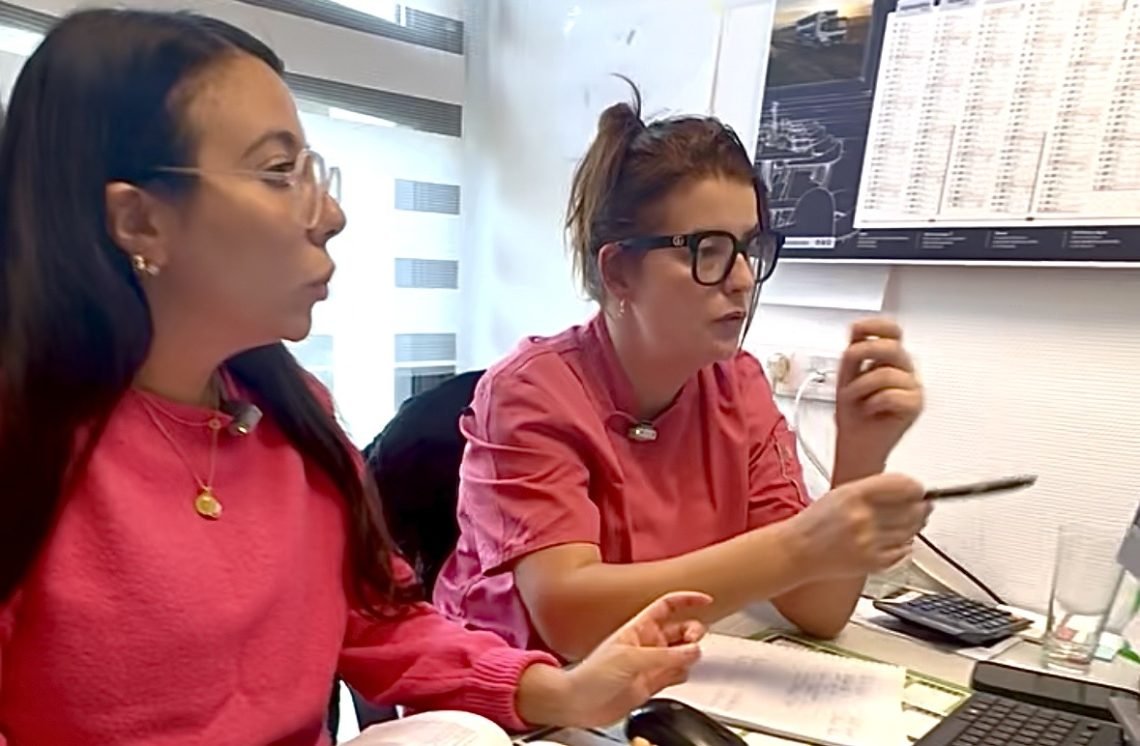
In November, I joined school chef Wendie Manderrier and school dietitian Catherine Piccolo for a menu-planning session at my local public elementary school in the Haute-Savoie region of France.
The municipal kitchen prepares approximately 600 lunches a day. Together, the two professionals were developing the menus for the next five weeks of school.
For a complete overview of the French school lunch system, see → French School Lunches: How They Work Today.
Planning Five Weeks of French School Lunch Menus
“Nutritional balance is achieved over time,” explains Catherine. “We want to include meals that meet children’s nutritional needs while also bringing them some enjoyment of food.”
Rather than assessing each lunch in isolation, the dietitian examines the frequency with which different categories of food appear throughout the menu cycle, taking into account sources of protein, fiber, vitamins and calcium.
Wendie brings her knowledge of seasonal produce, menus, cooking, suppliers, food prices, kitchen logistics and, importantly, the eating habits of the children for whom she cooks every day.
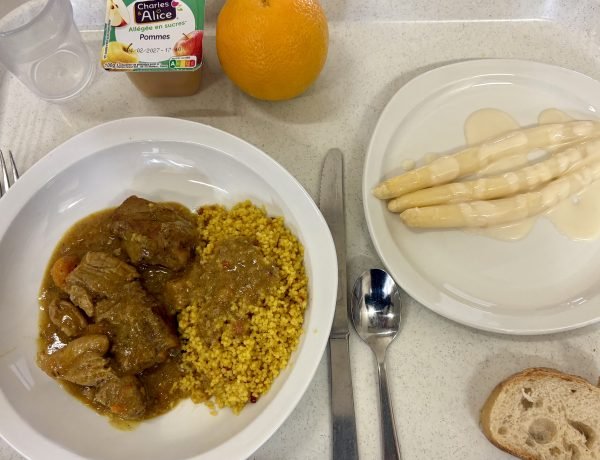
For examples of the meals served at this school, see a typical French school lunch menu.
France’s National School Lunch Nutrition Requirements
The nutritional composition of French school lunches is governed by national regulations introduced in September 2011, which specify how frequently certain categories of food must be served over 20 consecutive meals.
Among the requirements:
- At least 10 starters or accompaniments containing raw vegetables or fresh fruit.
- At least eight desserts consisting of raw fruit.
- Ten main-course accompaniments consisting of cooked vegetables, excluding pulses.
- Ten main-course accompaniments consisting of pulses, starchy foods or grains.
- At least four main courses containing qualifying portions of non-minced beef, veal, lamb or offal.
- At least four main courses containing fish or qualifying fish preparations.
Additional requirements govern the calcium content of dairy products, limit the frequency of certain high-fat, fried and sugary foods, and address age-appropriate portion sizes.
For a more detailed look at these regulations, see → French School Lunch: Official Nutrition Guidelines.
Join my free monthly newsletter
for everyday French life, simple habits & sustainable wellbeing.
And get The French Guide to Everyday Wellbeing straight to your inbox!
Organic Food, Sustainability and the EGAlim Law
France’s 2018 EGAlim law and subsequent legislation introduced additional requirements concerning the quality and sustainability of food purchased by public-sector cafeterias.
At least 50% of annual food purchasing expenditure must be allocated to products meeting designated quality or sustainability criteria, including at least 20% organic products.
Since January 2024, at least 60% of expenditure on meat, poultry, fish and seafood combined must also meet qualifying criteria. School cafeterias must also offer at least one vegetarian menu each week.
During the menu-planning session, a brief exchange about broccoli illustrates how these requirements influence individual decisions.
“They love broccoli.”
“Perfect, we’ll put organic broccoli on the menu.”
The choice takes into account both the children’s preferences and the kitchen’s organic purchasing obligations.
Nutritional Balance in Practice: Fiber, Vitamins and Fresh Produce
During the discussion of a proposed menu featuring homemade tabbouleh, lentil dhal and fromage blanc (similar to a plain yogurt) with fruit, Catherine examined whether the meal provided a meaningful serving of raw fruit or vegetables.
Although the tabbouleh contained tomatoes and the lentil dish contained herbs, the quantities were not necessarily sufficient. The lentils themselves, however, were an excellent source of dietary fiber.
Catherine explained the importance of including raw fruit or vegetables, particularly as a source of vitamin C, which is sensitive to heat and can be diminished during cooking.
The discussion resulted in the inclusion of a fresh apple.
When selecting raw vegetable starters, Wendie takes two principal factors into consideration:
“The raw vegetables they like and seasonal produce available.”
Balancing Food Costs, Local Sourcing and Kitchen Logistics
Meeting nutritional requirements while remaining within the school kitchen’s food budget requires considerable planning.
Catherine explained that non-minced beef, veal and lamb are among the more expensive meats to serve. Incorporating them into dishes with sauces or composite dishes, while respecting nutritional requirements, is one way of managing costs.
Wendie also uses collective purchasing arrangements and procurement contracts to obtain more favorable prices.
“If I see that the market price is too high, I know I’ll have to change the meat,” she explains.
Although menus are established five weeks in advance, food orders are placed weekly, on Tuesdays for delivery on Fridays. This accommodates the kitchen’s storage capacity and allows Wendie to take current prices and availability into account.
Local and seasonal ingredients also influence her choices. When I asked about regional sourcing, she cited Alpina semolina for homemade tabbouleh and locally grown apples.
“It’s apple season in Savoie, so we buy apples from Savoie.”
Cooking times are another consideration. During a discussion about scheduling a beef dish, Wendie explained that it requires a minimum of five hours of cooking.
“For the beef to be tender. Otherwise, they won’t eat it.” Consequently, some dishes need to be prepared the day before serving.
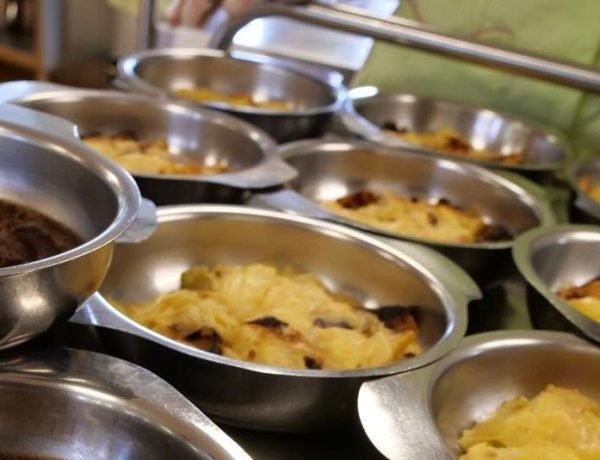
For a closer look at the preparation of hundreds of school lunches each day, see A Look Inside a French School Cafeteria Kitchen.
The School Dietitian’s Role Beyond French School Lunch Menu Planning
Catherine’s responsibilities extend beyond reviewing menus. She also spends time with children during lunch, encouraging them to taste different foods and explain what they like or dislike about them.
“Children tend to say they don’t like something when, in fact, they don’t even know what’s on their plate.”
Her approach involves asking children simple questions:
“Do you know what it is? Do you know what it tastes like? Have you tasted it before?”
These exchanges form part of what is known in France as l’éveil au goût, or taste education, encouraging children to try unfamiliar foods, identify ingredients and describe flavors.
Catherine has also plans to provide training for kitchen staff in food microbiology and hygiene, and hopes to develop additional taste education workshops for children.
Read here about how the French avoid picky eaters and how they educate children about taste and variety of foods.
Reviewing the French School Lunch Menus
Toward the end of the session, Catherine returned to her calculations and identified an imbalance in the proposed menus.
“I’m recalculating everything over the five weeks, and we have more starchy foods than vegetables as side dishes, so we’ll need to make some changes.”
The menus would be adjusted accordingly before being finalized.
More From France
If you’re curious about how France nurtures healthier habits — from school lunches to everyday food, movement, and wellbeing — I share practical tips and stories each month. Sign up for the free newsletter below and receive my guide, The French Guide to Everyday Wellbeing, straight to your inbox. Merci!
Come see it for yourself!
Follow along on Instagram and TikTok for real footage from inside French school cafeterias and kitchens, plus everyday life in France.