
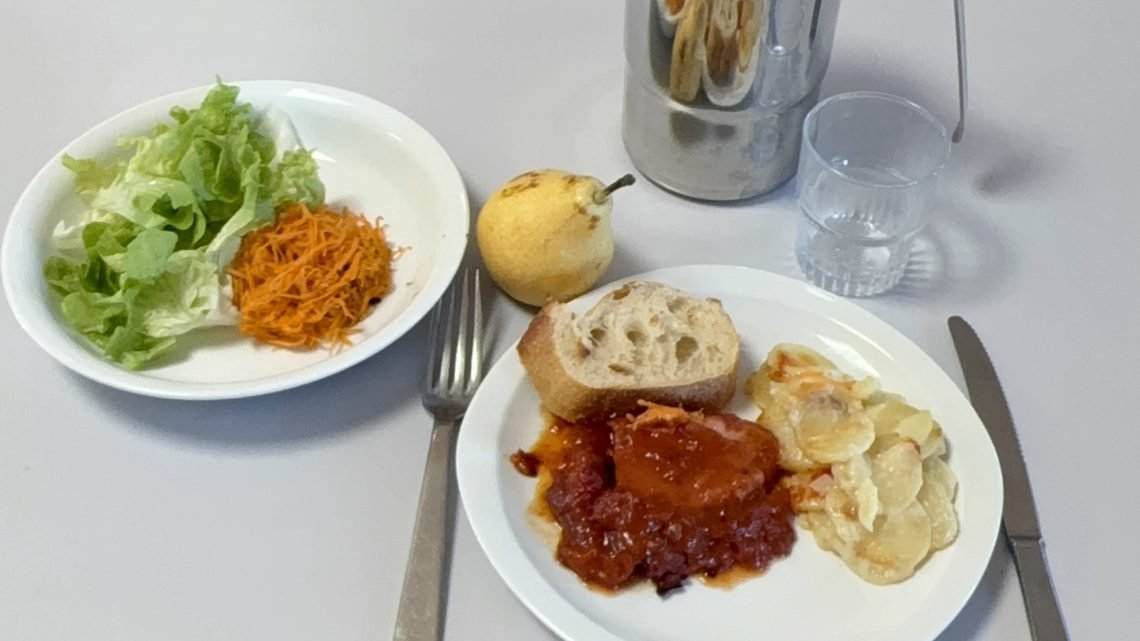

Every time I share a video about French elementary school lunches, a few familiar comments appear.
“That must be a private school.”
“There’s no way ordinary French children eat like this.”
Or, from people who grew up in France: “My school lunches looked nothing like that!”
And occasionally, someone will suggest that the videos are fake or even propaganda.
I understand the questions. The meals I film can be impressive: freshly prepared vegetables, homemade soups, traditional French dishes, cheeses and seasonal fruit. All prepared for hundreds of children, often by a relatively small kitchen team.
But there’s something I want to clarify.
I only film in public elementary schools. I’ve visited many over the years, spending time with the chefs and kitchen staff, watching meals being prepared and served, and observing how children eat.
There’s also an assumption that private schools must serve better lunches than public schools. But that isn’t necessarily true. French elementary school lunches can be remarkably ambitious, and paying for private education doesn’t automatically mean children receive better food.
The lunches you see in my videos are real. But that doesn’t mean every public elementary school in France prepares or serves lunch the same way.
If you’re new to the subject, my complete guide to French school lunches explains how the system works, what children eat and why lunch is such an important part of the French elementary school day.
Not All French Elementary Schools Cook Their Own Meals
The kitchens I’ve filmed prepare their meals on-site. Staff arrive early to wash and chop vegetables, prepare sauces, cook main dishes and get everything ready before the children arrive.
But other French public elementary schools receive meals from centralized kitchens, known as cuisines centrales, which prepare food for several schools.
These kitchens may be operated by municipalities or by private catering companies. Some municipalities also outsource their school catering to companies such as Sodexo.
A public school doesn’t necessarily have a publicly operated kitchen. And a meal prepared away from the school isn’t necessarily produced by a private company.
I’m planning a visit to a privately operated central kitchen whose founder originally worked in a school kitchen. As his operation expanded, he continued using school kitchens until the business became too large and required its own facility.
I’m curious to see how the process works on a larger scale and what happens between the central kitchen and the children’s plates. Regardless of how meals are prepared, public elementary school catering must follow national nutritional guidelines.
Join my free monthly newsletter
for everyday French life, simple habits & sustainable wellbeing.
And get The French Guide to Everyday Wellbeing straight to your inbox!
Does a Wealthier Neighborhood Mean Better School Lunches?
Not necessarily.
Take Paris, for example.
Some of the city’s less affluent neighborhoods have particularly ambitious public school lunch programs.
In the 20th arrondissement, the public school catering service reported that 62% of its food purchases were organic in 2024. It also received an award recognizing its commitment to fair sourcing from French producers.
Meanwhile, in Paris’s 18th arrondissement, local authorities are investing in neighborhood kitchens that prepare meals for nearby schools.
Neither example proves that every lunch served is excellent. But they do challenge the assumption that a school’s location tells you how well its children eat.
And Paris is just one example. Across France, municipalities make their own decisions about budgets, ingredients, staffing and how their elementary school lunch services operate.
What You Don’t Always See in My Videos
I’ve spent enough time in school kitchens and following school chefs around to know that things don’t always go exactly according to plan.
Sometimes the challenges begin before the working day has even started. A staff member calls in sick at 6 a.m., or someone needs to take a young child to the doctor. Suddenly, a kitchen that was already working on a tight schedule is short-handed, with hundreds of lunches still to prepare.
I’ve listened to conversations about children wanting larger portions of potato gratin instead of the cooked vegetables, leaving the kitchen unexpectedly short of gratin.
I’ve watched a chef notice that children hadn’t been eating many of their vegetables during the week. By Friday, she decided to blend the vegetables into a soup for lunch. The children loved it.
And I’ve seen the occasional glitch. Once, during a particularly hectic lunch service, there appeared to be a shortage of the main dish. In fact, another oven still contained enough food, but it had been overlooked during the rush.
These are professional kitchens, but they’re also run by human beings.
And feeding hundreds of children every day involves constant adjustments, problem-solving and a fair amount of improvisation.
It’s one of the things I find most interesting about spending time behind the scenes.
“But My French School Lunches Were Nothing Like This!”
I believe you.
France is a big country, and school catering varies from one municipality to another. What children eat today may also look very different from what was served 10, 20 or 30 years ago.
And even within the same school, not every lunch is equally successful.
A beautifully written menu doesn’t guarantee a delicious meal. A photograph doesn’t tell you whether children enjoyed the food, whether it was served at the right temperature or how much ended up being thrown away.
That’s why I’m interested in more than the finished plate.
I want to understand the people, the decisions and the organization behind it. Just as interesting is watching the children eat, listening to their conversations and occasionally asking them what they think of the food.
There’s Still More I Want to Discover
I’ve been fortunate to spend time with chefs who take enormous pride in feeding children well. I’ve seen the care that goes into their work, but also the challenges of running a busy kitchen on a tight schedule and limited budgets.
What I haven’t yet documented is the experience of schools whose meals are prepared elsewhere.
That’s the next part of the story I will explore, and write about more here.
Because the question isn’t really whether every French elementary school lunch looks like the ones I film.
It’s how different communities decide to feed their children — and what those decisions mean for the meals they eat every day.
Read More
What Happens When a Society Decides Feeding Children Well Matters?
What do French kids really learn at school lunch?
What are children eating in Paris elementary school cafeterias?
More From France
If you’re curious about how France nurtures healthier habits — from school lunches to everyday food, movement, and wellbeing — I share practical tips and stories each month. Sign up for the free newsletter below and receive my guide, The French Guide to Everyday Wellbeing, straight to your inbox. Merci!
Come see it for yourself!
Follow along on Instagram and TikTok for real footage from inside French school cafeterias and kitchens, plus everyday life in France.