
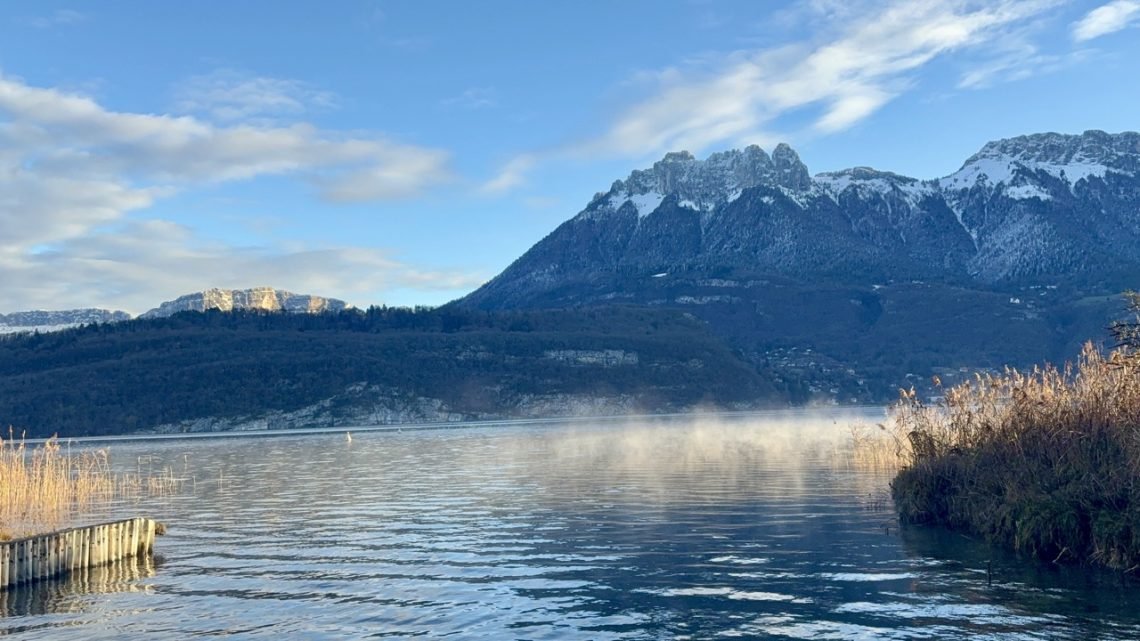

More than ten years ago, I co-founded a cold water swimming club with my American bestie, Liz. We didn’t have a grand plan or a wellbeing philosophy in mind. We were simply two swimmers who adored slipping into Lake Annecy in late spring and summer — and one day we wondered, Why not keep going when the temperature drops?
In true French fashion, we sought guidance from people who knew what they were doing. The Vikings — a legendary cold water swimming club across the lake — took us under their wing. They taught us the technical bits, the safety rules, and the culture of the sport. In hindsight, thank goodness for them.
Even with their help, we made countless mistakes in those early years. But with only a tiny handful of members, the learning curve was oddly fun. None of us imagined that winter swimming would eventually become “a thing,” let alone that our little club would grow large enough to require a waiting list.
Today, cold water swimming is often celebrated for its potential health benefits, particularly its effects on mood and wellbeing. Research is still developing, however, and claims about immunity, circulation, and cardiovascular health aren’t as clear-cut as they’re sometimes presented.
But the real lessons — the ones that have shaped my wellbeing over the past decade — are quieter and much more personal.
For an overview of everyday French wellbeing habits, start with → The French Approach to Wellbeing.
Here are the ten things winter swimming has taught me.
1. Identity Is Flexible
I’ll start with the obvious: I hate cold water. Truly. I’m a steaming-hot-shower kind of person, even after ten years of doing this.
New swimmers often assume cold water people are built differently — as if we’re polar bears in disguise. But the truth is delightfully simple: I wasn’t born loving cold water. I gradually learned to do something I never imagined enjoying.
This sport taught me that self-perception is elastic — and sometimes wildly inaccurate. We talk ourselves out of new experiences all the time, simply because they don’t fit the identity we think we have.
2. The Comfort Zone Is Overrated
Winter swimming is a weekly reminder that some of life’s most memorable experiences happen outside your comfort zone.
On windy, blustery days, I stand in my hallway thinking, There’s absolutely no way I’m going in today.
And yet… almost every time, I go.
Ten years of practice has made me braver in small, everyday ways. Once you’ve learned to face something that intimidates you, saying yes to other challenges feels a little easier.
Of course, there’s an important difference between stepping outside your comfort zone and ignoring your body’s warning signs. Winter swimming has taught me both.
3. It’s Mental Exercise as Much as Physical
For me, cold water swimming is as much a mental challenge as a physical one.
It requires managing your mind. Staying calm. Recognizing the body’s initial response to cold water without trying to prove anything.
Cold shock can cause involuntary gasping and rapid breathing, which is why entering gradually and staying within your abilities is so important.
Over time, I’ve learned that the goal isn’t to push further or stay longer. It’s to pay attention, remain sensible, and know when to get out.
More is not always better — a deeply French idea, actually.
Join my free monthly newsletter
for everyday French life, simple habits & sustainable wellbeing.
And get The French Guide to Everyday Wellbeing straight to your inbox!
4. Mind Games Help
My hardest moment is the first immersion.
Years ago, I started counting down from ten as a way to focus my mind while entering the water gradually. Then I count back up to ten to give myself a moment to settle.
It’s a tiny ritual, but it helps me feel more composed.
I don’t use the countdown to force myself into the water if something feels wrong. It’s simply a way of managing the anticipation.
I’ve discovered that small rituals can make challenges feel more manageable — in the lake and in life.
5. Nature Is Medicine
One of the things I appreciate about life in France is the importance placed on spending time outdoors — walking, moving, and enjoying fresh air.
Cold water swimming combines that with the extraordinary beauty of the Alps and the stillness of Lake Annecy.
Some mornings, the mountains are barely visible through the mist. Other days, the water is perfectly clear, and the surrounding peaks seem close enough to touch.
Even before I enter the lake, I feel better for having made the effort to be outside.
For me, that connection with nature is one of the greatest rewards of winter swimming.
6. Wellbeing Doesn’t Always Look Like “Fitness”
For years, I believed exercise only “counted” if it involved sweating, pounding the pavement, or collapsing afterward.
France changed that belief, and winter swimming reinforced it.
Of course, cold water swimming isn’t a substitute for regular exercise, strength training, or cardiovascular fitness. But it has taught me that wellbeing can also come from rituals, time outdoors, friendships, and doing something simply because it makes you feel good.
The older I get, the more this truth feels like a gift.
When I finally realised self-care was important, this is what I discovered → 10 Ways French Women Practice Self-Care.
7. Limits Are Wisdom, Not Weakness
Pushing yourself is one part of the sport; listening to your limits is the other.
After years of winter swimming, I’ve become much more attentive to how I feel before, during, and after getting into the lake.
But experience doesn’t make anyone immune to the risks of cold water. Conditions change, and the body doesn’t always respond in the same way.
Staying in too long can be dangerous. And like any activity done with others, it’s easy to follow the crowd.
Cold water has taught me to tune in, not out.
Getting out before everyone else isn’t failure. Sometimes it’s the smartest decision you can make.
8. Age Is Real — and So Is Ageing Well
I’ve never liked the phrase “age is just a number.”
Age is age. A 50-year-old is not a 30-year-old, no matter how young we feel.
But ageing well is absolutely something we can work toward.
Our club ranges from 18 to 80+, and some of our oldest swimmers are among the most joyful, courageous, and steady people I know.
They inspire me constantly.
Of course, cold water isn’t suitable for everyone, and individual health matters far more than age alone.
But watching people continue to enjoy nature, friendship, and new challenges well into later life has changed the way I think about growing older.
It’s a reminder that pleasure, movement, and community matter at every stage of life.
There are many ways to age well, including some I’ve observed among French women → How French Women Age Naturally and Well.
9. There’s No Right Way to Do It
One of the things I love about our club is that everyone approaches the water differently.
Some people swim short distances. Others prefer to stay close to shore and enjoy a brief dip. Some keep their heads above water throughout.
There isn’t a competition to see who can endure the most cold.
Personally, I’ve learned that the experience matters far more than the performance.
And although I’ve experimented with putting my face in the water, it’s not something I would recommend as a goal. Sudden facial immersion in very cold water can place additional stress on the body.
The pleasure of winter swimming doesn’t depend on how long you stay in or how much of yourself you submerge.
10. Safety Is the Foundation
In more than ten years, we’ve never had an emergency, and I hope it stays that way.
From the beginning, the Vikings taught us that cold water swimming deserves respect.
It’s why we take safety seriously, even after years of experience.
If you’re interested in trying it, seek medical advice first, particularly if you have a heart condition or other health concerns. Learn from an experienced, safety-conscious group rather than attempting your first winter swim alone.
Never enter cold open water alone. Choose a safe entry and exit point, stay close to shore, and avoid jumping or diving into cold water.
A brightly coloured swimming cap and a suitable tow float can help others see you, but neither replaces supervision or a safe plan.
And forget rigid formulas about how many minutes you can stay in based on the water temperature. There is no universally safe immersion time.
Cold shock, loss of coordination, hypothermia, and continued cooling after leaving the water are all real risks.
Above all, listen to your body, leave the water early, and have warm, dry clothing and a safe place to recover afterward.
Getting out early isn’t failure — it’s maturity.
What Ten Years of Winter Swimming Have Taught Me
After a decade of doing this, winter swimming feels less like a sport and more like a grounding ritual.
It’s a reminder that my body is capable, my mind is adaptable, and age is not something to resist but to partner with.
It’s also taught me that the most meaningful parts of wellbeing aren’t always the ones we can measure.
It’s a philosophy I explore further in The French Approach to Health: Why There Are No Hacks.
Sometimes they’re found in friendship, a familiar weekly ritual, a beautiful place, and the satisfaction of doing something you once thought impossible.
Winter swimming has been one of the most unexpected gifts of my life in France — a blend of nature, community, courage, and a little bit of French joie de vivre, even on the iciest mornings.
More From France
If you’re curious about how France nurtures healthier habits — from school lunches to everyday food, movement, and wellbeing — I share practical tips and stories each month. Sign up for the free newsletter below and receive my guide, The French Guide to Everyday Wellbeing, straight to your inbox. Merci!
Come see it for yourself!
Follow along on Instagram and TikTok for real footage from inside French school cafeterias and kitchens, plus everyday life in France.