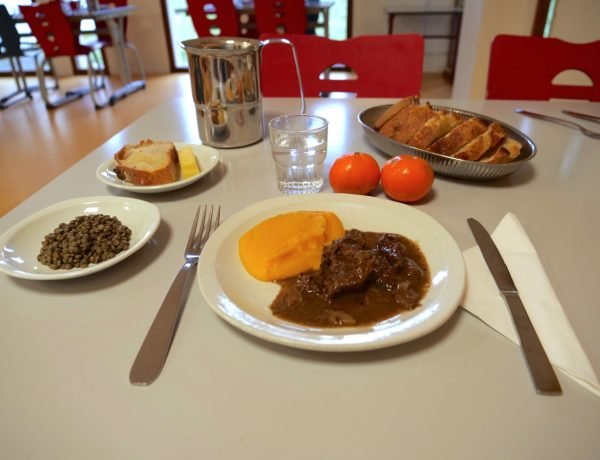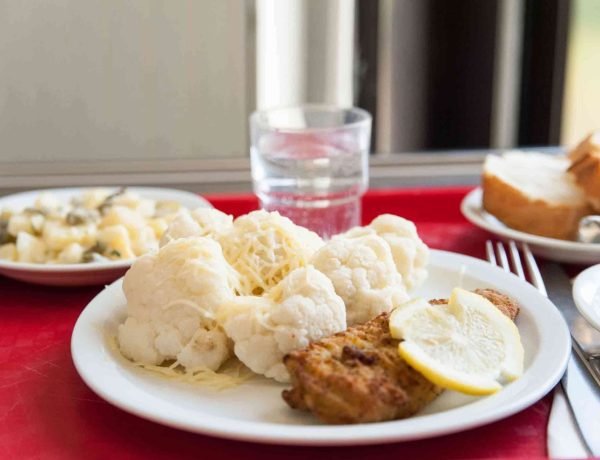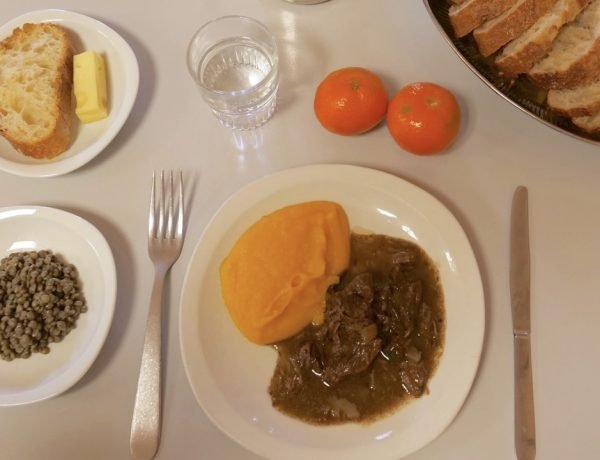


I followed one such school chef over several days to better understand what a typical day actually entails. What is the day in the life of a French school chef really like?
A school chef in France has a demanding job. She manages kitchen staff in every sense of the word, works at the fast pace of any professional kitchen, cooks for hundreds of children, responds to parents’ expectations, answers to the local government that employs her, and works within national nutrition standards that are among the most precise in France — especially for young children, from three-month-old babies in daycare to eleven-year-old fifth graders (including requirements for organic and local foods, as well as one fully vegetarian meal each day).
For a complete overview of the French school lunch system, see → French School Lunches: How They Work Today.
Before the kitchen wakes up
At 6:30 a.m., I met Wendie by the lake where she walks her dogs each morning before heading to work. It’s the quietest part of her day. By 7 a.m., she’s usually at the school, opening the kitchen and receiving the day’s deliveries — bread every day; fruits and vegetables once a week, on Mondays; and meat along with other pantry items on Fridays. The rest of the team arrives between 7:00 and 7:30, and by 8 a.m., cooking is well underway.
Cooking for hundreds
One of the days I shadowed her, the menu was beef bourguignon with whole-wheat pasta as the main course, a salad as the starter, followed by cheese and fruit for dessert. The beef had been started the day before because, as Wendie explained, “the flavors need to settle — it tastes much better the next day.” In an industrial-sized cooking vat, she was finishing the dish and adjusting seasoning before service.
More than 600 meals are prepared daily in this kitchen by a full-time staff of four. While Wendie worked on the main dish, the rest of the team moved quickly through their tasks — preparing meals that would later be delivered to the local daycare and maternelle, the kindergarten for children aged three to five.
Like in an episode of The Bear, everyone has their own station, but there’s constant overlap. Instructions are called out over the hum of kitchen machinery, doors open and close to the cold room, freezer room, pantry, and vegetable storage. For a solid two hours, the kitchen runs at full speed — finishing the main dish, preparing the cafeteria, cutting bread, washing and portioning fruit, assembling salads.
Throughout all of this, Wendie is the constant point of reference. Questions come at her nonstop: How long does this stay in the oven? What time does that come out? Where is the extra tray? Who’s handling the delivery? She answers without breaking stride, moving from station to station, keeping the rhythm of the kitchen intact.
Hygiene and food safety are ever-present. Thermometers are used repeatedly to check temperatures, samples of every cooked dish are stored in the refrigerator in case of an issue, surfaces are cleaned continuously as cooking progresses, and waste is carefully sorted for recycling.
Join my free monthly newsletter
for everyday French life, simple habits & sustainable wellbeing.
And get The French Guide to Everyday Wellbeing straight to your inbox!
Lunch as a shared moment
At 11 a.m., the staff sit down together for repas du personnel — a short “family meal” eaten in the cafeteria. Whoever has a free moment sets the table with the same plates, glasses, and silverware the children use, pours water, places a basket of bread at the center, and everyone eats what has just been cooked. There’s laughter, gossip, and shop talk. Twenty minutes later, the table is cleared, the space cleaned, and final preparations begin before the first students arrive around noon.
What children learn at the table
Once service begins, small moments repeat themselves quietly. When a child says they don’t like something, the adult serving them doesn’t argue or insist. They simply ask whether the child would like to try just a little. Almost half the time, the answer is yes — just a small portion, just a taste. That moment matters. It removes pressure while keeping the door open, and over time it changes how unfamiliar food is approached.
Meals are eaten seated, at small tables of four to six children. Voices stay at conversation level. There’s no running around, no grazing, no getting up and down — lunch is a shared, structured moment. The rules are simple and consistent, and because of that, they don’t need to be enforced loudly.
Throughout the meal, cafeteria helpers and kitchen staff gently remind children to say please and thank you when food is served. It’s not done ceremoniously, and it’s not framed as a lesson — just a quiet expectation, repeated day after day, until it becomes automatic. Like everything else at lunch, it’s handled calmly and without drama.
An alternative dish is sometimes prepared for children with specific dietary needs. When children who are not concerned ask for the alternative, the response is calm and matter-of-fact: that’s for the children who need it. No apologies, no explanations, no negotiation. The main meal is served, and the line keeps moving. What struck me was not the rule itself, but how easily it was accepted. There was no whining, no sense of unfairness — just a clear boundary, consistently applied.
This particular school has two dining rooms — one for younger children in first through third grade, and another for fourth and fifth graders. Staff and cafeteria helpers serve the food and keep things moving, while additional helpers focus on supporting the youngest children.
Read More → 5 reasons French school lunches are important (it’s not the food)!
After service
Once service ends, the kitchen shifts immediately into cleanup mode. Dishes, floors, appliances, and equipment are washed, wiped down, and disinfected. By early afternoon, the kitchen is reset and ready to begin again.
Wendie then disappears into her office to handle food orders, prepare upcoming menus, take inventory of pantry stock, and design meals that avoid waste while remaining within nutritional guidelines. Twice a year, the commission de menu meets. They review menus, discuss how the cafeteria is functioning, and decide what needs improvement.
While she was alone in her office, I asked Wendie why school lunches matter to her. Aside from going through the details of a day in the life of a French school chef, I listened to her talk about her work.
“I like being in contact with the children every day. What do they like, what they don’t like, what they would like,” she told me. “I don’t want to be the kind of chef who stays hidden in the kitchen. When I can, I’m out in the cafeteria. It makes my job interesting, and it’s the reason I get up in the morning.”
By 2:30 p.m., Wendie is usually on her way home. Unless, of course, there’s a municipal event that day requiring additional catering, in which case the kitchen shifts into yet another mode. Tomorrow’s menus are already taking shape. The typical day in the life of a French school chef ends in the afternoon. But tomorrow it’s an early rise again in the morning to take the pups out before work.
Long before children sit down to eat — and long after they leave the table — this is the work that makes school lunch feel ordinary.
Working with a French school chef, I created a downloadable guide featuring some of the best-loved recipes served in French school cafeterias → Explore the French School Lunch Recipe Guide
More From France
If you’re curious about how France nurtures healthier habits — from school lunches to everyday food, movement, and wellbeing — I share practical tips and stories each month. Sign up for the free newsletter below and receive my guide, The French Guide to Everyday Wellbeing, straight to your inbox. Merci!
Come see it for yourself!
Follow along on Instagram and TikTok for real footage from inside French school cafeterias and kitchens, plus everyday life in France.